Mulcher Rotor Balancing
Eliminate Vibration, Protect Bearings, and Extend Equipment Life
Why Does a Mulcher Start Vibrating?
A mulcher is powerful equipment for shredding wood and brush. Its rotor operates in an aggressive environment, inevitably leading to imbalance. The main causes include:
- Uneven Wear: Hammers or knives wear down at different rates.
- Mechanical Damage: Loss of a hammer, impact with rocks, or deformation of the rotor tube.
- Debris Accumulation: Buildup of dirt, sap, and wood chips in hidden cavities.
- Repair Work: Replacement of holders or hard-facing welding without subsequent balancing.
Consequences of Ignoring Vibration
Operating with high vibration isn't just uncomfortable for the operator. It's a direct path to expensive repairs:
| Problem | Consequences |
|---|---|
| Bearing Failure | Equipment downtime, expensive parts replacement. |
| Housing Cracks | Loss of mulcher geometry, costly welding repairs. |
| PTO Load | Risk of damaging the tractor's PTO shaft and transmission. |
How Balancing Works: Step-by-Step Guide
For field balancing (in-situ), we use the Balanset-1A device. This allows balancing without removing the rotor, saving time and money on disassembly.
Step 1: Preparation (Critically Important!)
Before turning on the device, mechanical preparation must be performed:
- Thoroughly clean the rotor. Often, vibration is caused simply by a chunk of dried mud.
- Check the integrity of the hammers. If even one is missing, install a new one.
- Check bearings for play. Balancing on worn-out bearings is pointless.
- Tighten all bolt connections.
- If there are elements obstructing access to the rotor (curtains, push frame), secure them or temporarily remove them.
Step 2: Installing Balanset-1A Sensors
The kit includes two vibration sensors and a laser tachometer (RPM sensor).
- Vibration Sensors: Installed on the bearing housing (left and right) using magnets. Installation direction should be perpendicular to the rotor's rotation axis.
- Tachometer: Mounted on a magnetic stand. A strip of reflective tape is applied to the pulley or shaft. The laser must be aimed strictly at the tape.
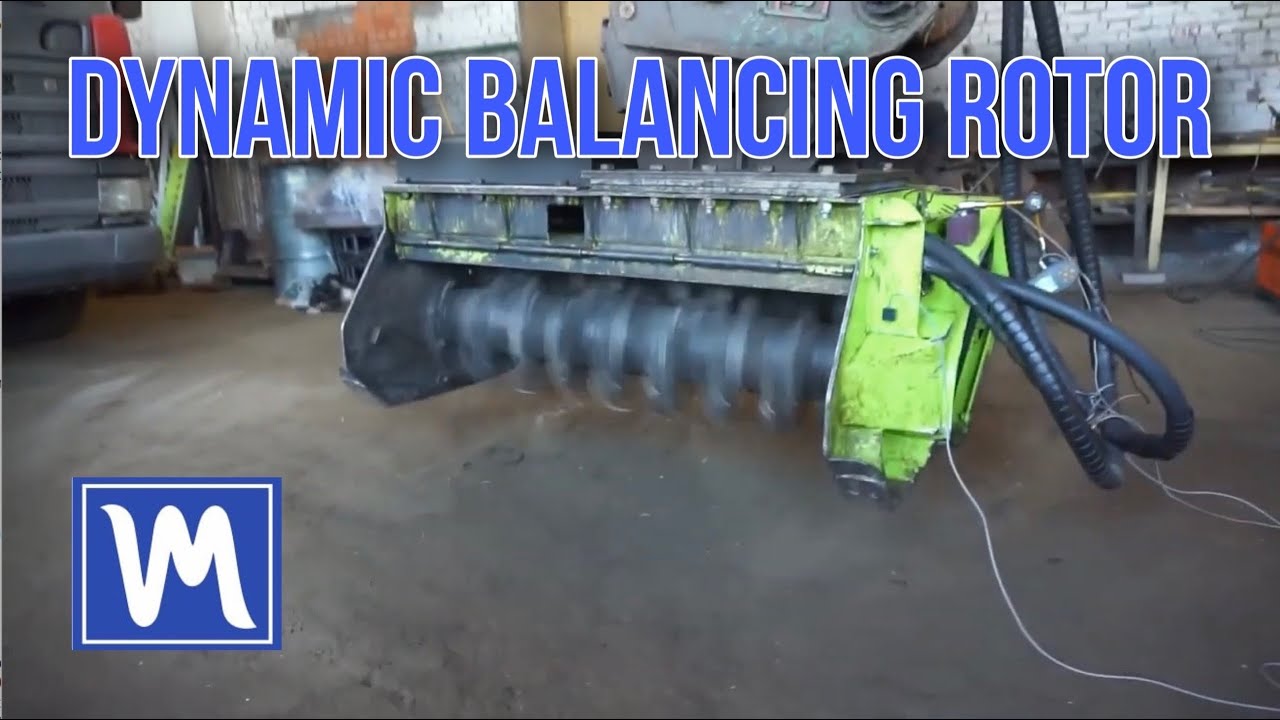
Video: Mulcher Rotor Balancing Process
This video demonstrates the real-world process of eliminating vibration on site.
Step 3: Measurement Process (Three-Run Method)
The Balanset-1A software guides the operator step-by-step:
- First Run (Initial): Start the rotor at operating speed. The device measures initial vibration and phase.
- Second Run (Plane 1): Install a calibration (trial) weight of known mass on the first side of the rotor (e.g., on the outer disk). Run the rotor.
- Third Run (Plane 2): Move the same weight to the opposite side of the rotor. Run the rotor.
Step 4: Installing Correction Weights
After three runs, the software automatically calculates:
- How many grams need to be added.
- Where (at what angle) to weld the weight.
Metal plates are typically used as weights, welded to the side disks or the rotor body. After welding, a verification run is performed to check the result.
Balancing Result
After a correct procedure, vibration levels typically decrease by 10-50 times, reaching values compliant with ISO 1940-1 accuracy class G6.3 or G16. This ensures quiet operation and equipment longevity.
Balanset-1A: Technical Specifications
Portable Balancer & Vibration Analyzer
Professional dual-plane balancing device for field use. Ideal for mulchers, fans, crushers, and other rotating equipment.
- Balancing planes2 (dual-plane)
- RPM range250 – 100,000
- Vibration measurement0.01 – 100 mm/s
- Accuracy classISO 1940-1 (G0.4 – G40)
- Sensors2 vibration + 1 laser tachometer
- ConnectionUSB (laptop)
- Report exportPDF
Frequently Asked Questions
Professional mulcher rotor balancing services typically cost between €300 and €600, depending on the complexity, rotor size, and location of the work. The price may be higher for remote areas due to travel costs. Alternatively, you can purchase the Balanset-1A device for approximately €1,975 and perform unlimited balancing operations yourself — this pays off quickly if you service multiple machines or offer balancing as a service.
Yes, absolutely. Field balancing (in-situ) is not only possible but is actually the preferred method for mulcher rotors. Using a portable device like Balanset-1A, you can balance the rotor directly on the tractor in the field without any disassembly. The rotor spins in its own bearings at operating speed, and sensors measure the actual vibration. This approach saves significant time, eliminates reassembly errors, and provides results in real working conditions.
Balancing is required after any change to the rotor's mass distribution: repair work (hammer or knife replacement), welding, hard-facing, or mechanical damage (impact with rocks or foreign objects). You should also balance when noticeable vibration appears during operation. Regular preventive balancing is generally not necessary if the rotor has not been modified and shows no signs of increased vibration.
You need a portable balancing device such as Balanset-1A, which includes: two vibration sensors with magnetic mounts, a laser tachometer with stand, reflective tape, USB interface, and balancing software. Additionally, you'll need a welding machine to attach correction weights to the rotor, and basic tools for preparation work (cleaning, tightening bolts). A laptop is required to run the software.
After proper balancing, the rotor should meet the ISO 1940-1 standard, typically achieving G6.3 or G16 accuracy class for agricultural equipment. In practical terms, this means vibration reduction of 10-50 times compared to the initial unbalanced state. You should feel a dramatic difference — the machine runs smoothly and quietly, with no excessive shaking of the housing or tractor.
Ready to Eliminate Vibration?
Get the Balanset-1A portable balancer and start balancing mulchers, fans, crushers, and other rotating equipment today. Professional results in field conditions.
Order Balanset-1A EN
EN  AR
AR  AZ
AZ  BG
BG  ZH
ZH  HR
HR  CS
CS  DA
DA  NL
NL  ET
ET  FI
FI  FR
FR  DE
DE  KA
KA  EL
EL  HE
HE  HI
HI  HU
HU  ID
ID  IT
IT  JA
JA  KO
KO  LV
LV  LT
LT  MS
MS  NB
NB  FA
FA  PL
PL  PT_BR
PT_BR  PT
PT  RO
RO  SR
SR  SK
SK  SL
SL  ES
ES  SV
SV  TH
TH  TR
TR  UR
UR  UK
UK  VI
VI 